

Hey, Hannatu here 👋
Long before pasteurisation plants, refrigeration trucks and supermarket milk cartons, West Africa already had dairy preservation experts.
They were the Fulani.
Stretching from Senegal and Mauritania in the west through Mali, Guinea, Burkina Faso, Niger and northern Nigeria to Cameroon, Chad and Sudan, the Fulani (also known as the Fulɓe or Peul) are among Africa's largest and most widely dispersed pastoral peoples.
Today, their population is estimated at more than 40 million people across about 17 countries.
While many now live in towns and cities, pastoralism remains central to Fulani identity across much of the Sahel.

Nowhere is that relationship more visible than in Nigeria.
Home to one of Africa's largest cattle populations, Nigeria's livestock sector is dominated by Fulani pastoralists, who own an estimated 80-90% of the country's $8 billion cattle economy.
Their annual migrations have shaped grazing systems, livestock markets and food cultures for centuries.
But perhaps their greatest contribution has been quieter.
They made milk part of everyday life.
To tell the story of milk in the Sahel is, in many ways, telling the story of the Fulani.
Across towns and highways, their products have become cultural icons.
Fura da nono, cool sour milk paired with spiced millet balls; kindirmo, a thick fermented milk; and wara or wagassi, the milk curds that are fried and sold in markets across the country.

For many West Africans, these foods are more than breakfast or roadside snacks.
They evoke road trips through Kaduna, Kano and Bauchi, small calabashes with large ladles (traditionally called ludayis), and Fulani women patiently stirring bowls of fermented milk beneath market umbrellas.
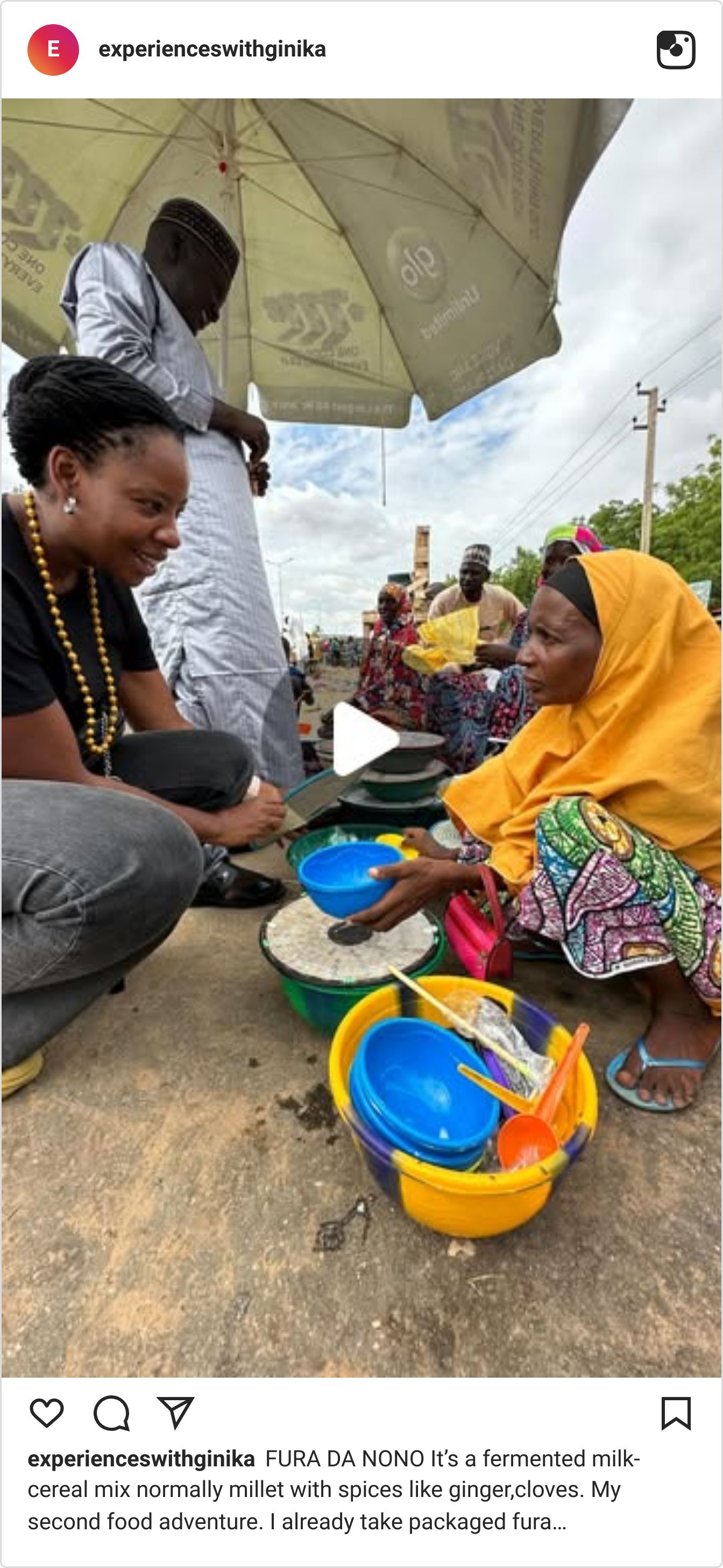
For generations, Fulani women have transformed fresh milk into foods that feed families, generate income and preserve indigenous knowledge.
Their work has strengthened trade between pastoral and settled communities while keeping centuries-old food traditions alive.
Yet behind every calabash of nono lies a problem as old as milk itself.
Milk and fire: the original cold chain
Fresh milk spoils remarkably quickly. We’ve written about this before.

Across much of the Sahel, daytime temperatures routinely climb above 35°C, meaning fresh milk can spoil within hours if left untreated. For pastoral communities constantly on the move, refrigeration was never an option.
Fulani households solved it centuries earlier.
Rather than depending on electricity or industrial machinery, they developed an indigenous preservation system built around careful heating, natural fermentation, cooling and patience.
It is a system refined over generations, using little more than firewood, aluminium pots, calabashes and experience.
Researchers studying pastoral dairy systems in Niger found that these traditional methods remain the backbone of milk preservation today.
Fresh milk is first strained through a clean cloth or sieve to remove any dirt, then gently heated to around 70–80°C. The milk is not allowed to boil.
After cooling naturally, it is either consumed as pasteurised milk or fermented into products such as kindirmo and nono.
That careful heating is striking because it closely resembles modern low-temperature pasteurisation.
Although developed independently of industrial dairy science, the objective is remarkably similar: reduce harmful microorganisms while preserving the qualities that make fresh milk desirable.
But heat is only part of the story. The real genius of Fulani dairy knowledge lies in what happens next.
The calabash knew about bacteria before the textbooks did
Across much of northern Nigeria and neighbouring Niger, milk is traditionally left overnight in calabashes to ferment naturally.
In other households, a small amount of fermented milk from the previous batch is added to fresh milk after heating and cooling, serving as a starter culture that accelerates fermentation.
By morning, the milk has thickened into kindirmo, which has a pleasant sourness that comes from naturally occurring lactic acid bacteria.
The science behind the process is elegant.
As beneficial bacteria multiply, they produce lactic acid, lowering the milk's pH and making it increasingly difficult for harmful microbes to thrive.

A Fulani woman shaking the gourd to separate milk and fat. Image source: Inside Africa
Researchers found that naturally fermented milk can remain safe to consume for up to 5 days during hot seasons and for as long as a week during cooler months.
It is preservation through microbiology that pastoral communities learned by observation long before they understood the language of bacteria.
And throughout this process, women remain the custodians of the craft.
Across Fulani communities, women strain the milk, control the heating, judge when fermentation is complete, and transform it into products sold across markets.
Among Hausa-speaking communities around Abuja, the process is almost described as a family ritual.
Fresh milk is collected at dawn, strained, and heated over a gentle fire. Once cooled, part of it is mixed with a little fermented milk from the previous day and left covered overnight.

Some milk cheese is being fried as wara. Image source: Inside Africa
Every step depends on knowledge passed from one generation to the next.
Which raises the question: what happens when that knowledge meets the gaps that even centuries of refinement couldn't fully close?
Old methods, new lessons
For decades, development conversations have often framed indigenous knowledge as something to modernise or replace. But the story of Fulani dairy suggests a more nuanced lesson.
Long before microbiologists understood beneficial bacteria or engineers built pasteurisation plants, pastoral communities had already discovered, through observation and experience, that gentle heating, controlled fermentation and careful cooling could preserve one of the world's most perishable foods.
Modern science has largely explained why those methods work. It has not rendered them obsolete.
Instead, the opportunity may lie in combining centuries-old knowledge with contemporary food safety standards.
Chilling tanks can preserve milk before processing. Stainless steel containers can reduce contamination. Better hygiene training can lower bacterial loads. None of these innovations require abandoning the indigenous techniques that have sustained pastoral families for generations.
Across Africa, where livestock production is expanding, but cold-chain infrastructure remains limited, that lesson is increasingly relevant. Innovation does not always begin with inventing something new. Sometimes it begins by recognising that communities have already solved part of the problem, and helping them build on that foundation.
For centuries, Fulani women have quietly transformed fresh milk into new products and countless family meals using little more than fire, calabashes and inherited knowledge.
Their methods might not deserve romanticisation or dismissal, but recognition, as practical innovations born of necessity, refined over generations, and still carrying lessons for the future of African food systems.
I’d like to hear from you this week.
If you've grown up eating fura da nono, kindirmo, nono, or wara, tell us about it. Where did you first have it? Is it still part of your life?
And the bigger question: do you think indigenous food knowledge like this should be formally protected and integrated into food safety standards? Or does modernisation inevitably mean leaving these traditions behind?
P.S: And if someone you know still thinks traditional African dairy is unsafe or outdated, this edition is worth sending their way.
Cheers,

